How to ensure safe forklift operation?
Forklift trucks are equipment widely used in warehouses, production facilities and construction sites. They are used to lift, transport and stack a wide variety of loads. However, due to their considerable weight, ease of manoeuvring and possible hazards during their operation, it is extremely important to follow strict health and safety rules. Forklift health and safety regulations are a set of rules and procedures designed to ensure safety when working with these machines. Proper caution, careful route planning and avoidance of excessive speed are important elements that help to reduce the risk of accidents in the workplace.
Principles of safe forklift operation

Adherence to safe driving rules an important key element of health and safety regulations for forklift operation. Proper adherence to these rules keeps the operator safe, but also other workers and people on the work site. Every forklift operator should know and apply the rules before starting work:
- speed and driving,
- visibility,
- cargo transport,
- lifting loads,
- braking.
Forklift truck should be operated with great care, especially in areas with limited visibility. The operator should always have a full view of the route. To maintain control, if the load obstructs visibility, it is advisable to drive the forklift in reverse. In terms of carrying and handling, any load being transported must be placed stably on the forks and its weight must not exceed the load capacity. The braking speed must also be adjusted to avoid sudden stops.
The role of health and safety training for forklift operators
Employers are required to organise regular health and safety training for forklift operators and for workers in their work areas. Training should cover forklift safety rules, but also emergency procedures. It is important that workers are kept up to date with current legislation and safety developments.
Ergonomics and safety at work with forklift trucks

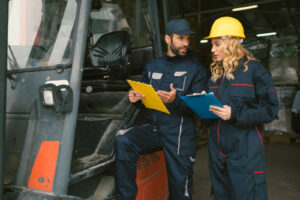
Safe forklift operation requires a number of rules to be followed. Operators should wear appropriate protective clothing, including a helmet and footwear with a hard sole. Before starting work, it is important to check the condition of the forklift, paying particular attention to brakes, tyres and warning signals. The ergonomics of the workstation are also of paramount importance. The seat must be adapted to the height of the operator, and levers and buttons should be easily accessible, helping to avoid back injuries. In harsh weather conditions, such as rain or snow, operators should exercise caution and transport routes must be cleared of snow regularly. In the event of a forklift breakdown or other hazard, operators should stop work immediately and report the problem to their supervisors. First aid training and knowledge of evacuation procedures are essential to respond effectively in emergency situations.
Importance of seat belts

A forklift truck should be equipped with seat belts and the operator is obliged to use them, in accordance with health and safety regulations. These belts have an important protective role, especially in the event of an accident. Their correct use can significantly reduce the risk of injury. Failure to do so can result in serious legal consequences for both the employer and the forklift operator themselves. For this reason, compliance with the rules on the use of seat belts is extremely important in any forklift operation situation.
Forklift safety and legal requirements
The use of powered forklifts is reserved for persons who have completed the relevant training and passed an examination, as evidenced by a certificate of qualification. The forklifts must be used for their intended purpose and in accordance with the manufacturer's recommendations, taking into account the technical specifications. Operators are required to hold a qualification certificate, which is issued by the Office of Technical Inspection (UDT). Persons with previous certificates may also operate forklifts, provided that their documents are valid.
Forklift trucks require regular technical inspections and maintenance, according to the manufacturer's instructions. The employer must offer safe working conditions, which includes marking of transport routes and proper forklift safety devices such as seat belts and warning signals. Loads transported by forklifts should be stably positioned and must not exceed the permitted load capacity. Operators should take special care when transporting heavy or tall loads. Employers are also required to organise health and safety training and provide operators with appropriate personal protective equipment such as helmets and protective clothing.
Safety rules around forklift trucks
To enable you to work safely near forklift trucks, there are a few rules to follow. One is to keep a good distance - you should not get too close to the track of the forklift or to the operator who is working. You need to be wary of loading zones - try to avoid areas where loading and unloading of goods takes place. Another rule of thumb is to make eye contact with the operator, i.e. before walking past the forklift, you should make sure that the operator can see the person. It is also important to wear protective clothing, such as reflective waistcoats and other personal protective equipment, when working in an area with forklifts. In addition to this, you should refrain from using the telephone and other activities that can distract and cause distraction.
Compliance with health and safety rules
Forklift operators must follow strict safety rules, such as adequate speed, visibility, stable load carrying and the use of seat belts. It is also important that employers organise regular health and safety training and provide ergonomic workstations. Compliance with health and safety regulations not only minimises the risk of accidents, but also protects workers from legal consequences.
Questions and answers
What are the health and safety rules when operating forklifts?
Basic health and safety rules include, but are not limited to, observing speed limits, providing full visibility to the operator, placing loads stably on the forks, avoiding carrying loads at maximum height and braking smoothly.
Does a forklift operator need to undergo training?
Forklift operators must complete specialised health and safety training and pass an examination to prove their qualifications. The employer must organise regular training and ensure up-to-date knowledge of health and safety regulations.
What personal protective equipment does the operator use?
Forklift operators should wear appropriate protective clothing, including a helmet, footwear with hard soles and reflective clothing. Caution is required in severe weather conditions, such as rain or snowfall, and transport routes should be properly prepared.
How to navigate around forklifts?
When in the vicinity of forklifts, keep a good distance, avoid loading zones, make eye contact with the operator and wear protective clothing such as reflective waistcoats. You should also avoid distractions, such as phone use, which can lead to dangerous situations.